AEO vs. SEO: All You Need to Know


Remember when getting found on Google meant picking a few solid keywords, tweaking your page, and waiting for the clicks to roll in?
Well, the landscape looks a bit different now. All of that still matters, but there are new players in the game today. Instead of scrolling through results and clicking around to compare pages, people generally just let AI Overviews and direct answer engines do the heavy lifting for them.
So what does that say about traditional SEO? Is it gone now?
The short answer is no. Why?
Because instead of just targeting those top few spots on the search page, we now also have to target ranking directly inside AI Overviews. And that simply cannot be done unless your SEO foundations are already rock solid. Answer Engine Optimization is not about throwing out your old playbook, but rather adding a new chapter to it so these new AI tools can easily read, trust, and quote your content.
1. What Is the Difference Between SEO, AEO, and GEO?
Understanding modern search requires distinguishing between three overlapping disciplines:
- SEO (Search Engine Optimization): The practice of improving a website’s organic visibility in traditional search engine results pages. It focuses on site architecture, technical health, keyword intent, link authority, and user experience.
- AEO (Answer Engine Optimization): The practice of structuring and refining information so that query-answering systems (AI assistants, voice search, featured snippets, direct answer engines) can understand, extract, and present it as a direct answer.
- GEO (Generative Engine Optimization): A specialized sub-discipline of AEO focused specifically on generative AI search environments (e.g., Google AI Overviews, ChatGPT, Perplexity, Claude).
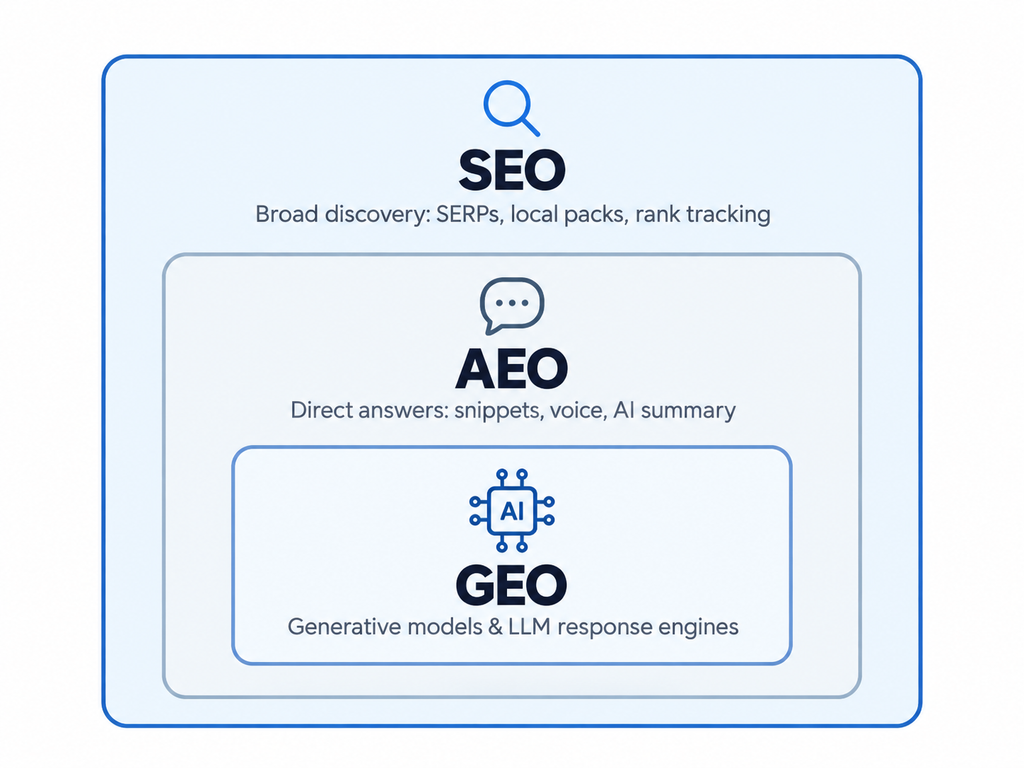
Key Takeaway: AEO and GEO are not replacements for SEO; they are targeted extensions of a strong underlying SEO strategy.
2. Side-by-Side Comparison Matrix
| Feature | Search Engine Optimization (SEO) | Answer Engine Optimization (AEO) |
| Primary Goal | Drive qualified user traffic to specific web pages. | Get cited, synthesized, or directly answered in search interfaces. |
| Primary Surfaces | Google SERPs, Bing, Local Packs, Image/Video search. | AI Overviews, AI Mode, ChatGPT, Perplexity, voice assistants. |
| Query Profile | Keywords, explicit transactional/informational phrases. | Conversational, multi-part, exploratory, long-tail questions. |
| Content Unit | Comprehensive web pages and landing page experiences. | Discrete information blocks, data tables, direct answers, facts. |
| Core Technical Need | Crawlability, indexing, page speed, mobile performance. | Clean DOM hierarchy, entity markup, extractable formatting. |
| Authority Signals | Backlinks, domain rating, page authority, user engagement. | Brand entity clarity, source citations, consistent web-wide facts. |
| Primary Metrics | Rankings, organic clicks, impressions, CTR, organic conversions. | AI citations, brand mentions, referral traffic from AI, share of model voice. |
3. Why Is AEO Becoming Essential?
Search behavior is shifting from browsing to direct answer consumption. Searchers can now get immediate responses before ever clicking a website link.
1. The Growth of AI-Powered Queries
Google’s conversational AI Search modes have expanded rapidly, surpassing over one billion monthly users. Crucially, queries in AI-driven search experiences average twice the length of traditional keyword searches. Users submit complex, multi-part questions rather than isolated keyword phrases.
2. The Rise of “Zero-Click” Interactions
Data from Pew Research Center highlights how AI answer summaries alter user behavior:
- Users clicked a traditional result in 15% of visits without an AI summary.
- That number dropped to 8% when an AI summary was displayed.
- Links embedded directly inside AI summaries generated clicks in only 1% of studied visits.
This shift does not make organic optimization irrelevant; rather, it changes how brand exposure occurs. A business can influence a buyer during the research phase through AI recommendations, cited sources, or product comparisons—even before the user visits the site.
4. Is AEO Just SEO with a New Name?
Yes and no. AEO relies on traditional SEO infrastructure, but it shifts how content is planned, structured, and formatted.
Google’s official developer documentation confirms that generative search features (such as AI Overviews) rely on Google’s existing core Search indexing and ranking systems. A page must first be indexed and eligible for regular search snippets to be cited in generative features.
Where They Overlap
- Core technical indexability and fast rendering.
- E-E-A-T (Experience, Expertise, Authoritativeness, and Trustworthiness).
- Clear page structure and logical internal linking.
Where Content Planning Changes
Traditional SEO keyword research often stops at high-volume head terms (e.g., “B2B cybersecurity software”). AEO content strategy maps the entire question tree surrounding that topic:
- What specific compliance standards does a mid-market provider need?
- How long does implementation typically take?
- What are the tradeoffs between managed security vs. in-house deployment?
- What are the core cost drivers when scaling from 100 to 500 seats?
5. How to Optimize for AEO Without Compromising SEO
A strong search strategy does not require two separate content production teams. Follow these five execution standards:
Step 1: Secure the Technical SEO Baseline
AI engines extract information from indexed web pages. Ensure your site has fast loading speeds, clean canonicalization, mobile accessibility, and clear internal link hierarchies.
Step 2: Adopt the “BLUF” Writing Method (Bottom Line Up Front)
State direct answers at the top of a content section, then follow with context, data, and nuances.
- Suboptimal Pattern: Three paragraphs of introduction leading up to a simple definition or figure.
- AEO Pattern: A concise 2–3 sentence direct answer, followed by detailed sub-sections, bullet points, and supporting arguments.
Step 3: Focus on Non-Commodity Information
Generic content easily generated by basic AI models is rarely cited as a primary source. AI search engines favor pages containing unique entity value:
- Original research, proprietary survey data, or benchmarks.
- First-hand case studies and real-world implementation notes.
- Clear comparisons based on actual product testing or service delivery.
Step 4: Use Extractable Structural Elements
Help machine parsers extract facts effortlessly:
- H2 and H3 Headings: Frame headings as clear questions or explicit entity titles.
- Tables: Format comparative data (pricing, features, specifications) using clean Markdown or HTML tables.
- Lists: Use ordered and unordered lists for sequential steps or feature lists.
Step 5: Build Consistent Brand and Entity Signals
AI engines rely on entity recognition across the broader web. Ensure your organization’s core facts, product offerings, leadership expertise, and service details are consistent across third-party industry directories, review sites, press mentions, and official documentation.
Read more on how to write content for AI search.
6. Myth-Busting: Schema, FAQs, and llms.txt
| Strategy | Reality & Best Practice |
| “Special AEO Schema” | Myth. Google explicitly states that no unique AI schema or proprietary machine tags are required for AI Overviews. Use standard Schema.org structured data (Article, Product, Organization, FAQPage) where relevant to content visibility. |
| “llms.txt Files” | Optional. While llms.txt files can help direct LLM crawlers to key text files, major search engines (like Google) rely on standard web crawlers and indexation pipelines. An llms.txt file will not fix thin content or poor technical SEO. |
| Keyword-Stuffed FAQs | Counterproductive. Generating pages with dozens of thin, repetitive FAQ items creates poor user experiences and risks triggering helpful content demotions. Focus on genuinely helpful, contextual Q&A. |
7. How to Measure Success Across SEO and AEO
Traditional search analytics measure direct click-throughs. AEO requires tracking both direct outcomes and indirect influence.
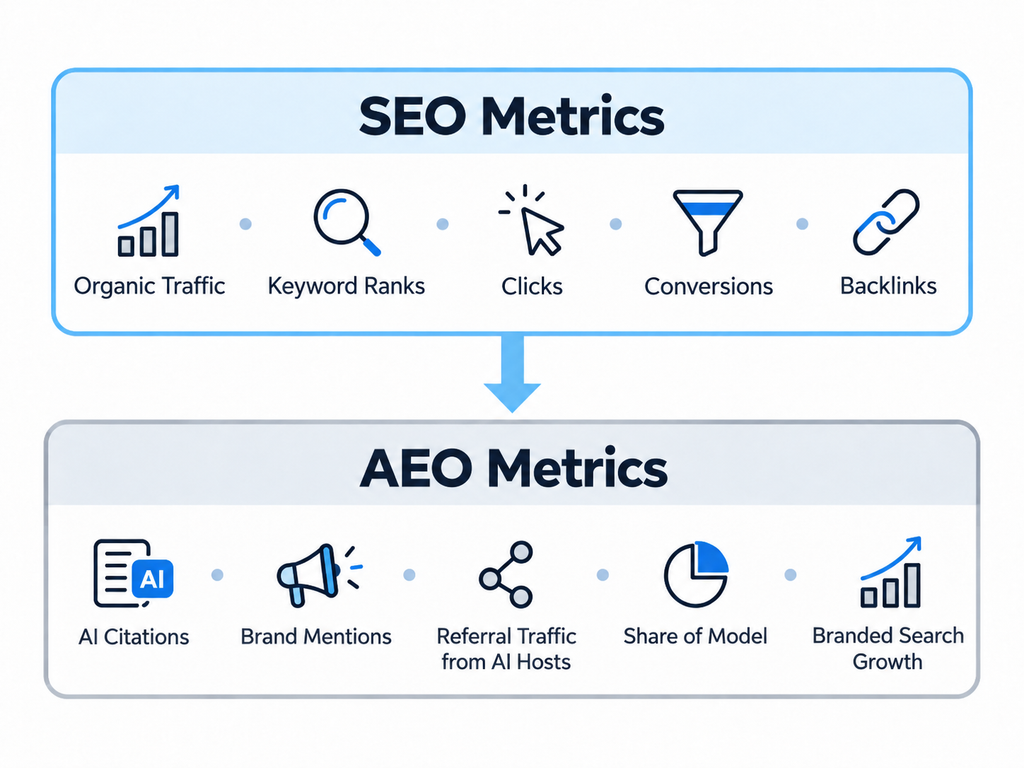
- Direct AI Referral Traffic: Track web traffic originating from AI tools (e.g., chatgpt.com, perplexity.ai).
- Citation Rate: Track how often your brand, domain, or key research is cited in target AI summaries for core commercial topics.
- Branded Search Volume: An increase in organic branded searches often indicates that prospective buyers discovered your brand inside AI-generated answers and searched directly for your site later.
- Pipeline and Conversions: Monitor self-reported attribution (“How did you hear about us?”) to capture lead paths driven by conversational search engines.
Final Verdict: Invest in Quality Search Optimization
At the end of the day, treating SEO and AEO as an either-or choice misses the bigger picture.Think of SEO as building the main highway that brings traffic into your city, and AEO as setting up the turn-by-turn signs that guide drivers directly to your front door. You do not have to pick a side; you just need both working together.
Search interfaces are going to keep changing, but the underlying goal never really changes. If you deeply understand what your audience is asking, share real expertise that cannot be easily copied, structure your pages logically, and keep your site technically healthy, you will be in great shape. Get those fundamentals right, and your content will automatically win.
If you’re struggling with your online visibility, request a free audit now to get actionable insights.

Popular Guides
View All Guides