How to Write for AI Search Without Losing the Human Touch


AI search has altered how people experience the results of their searching.
A person can now ask a detailed question, and get an answer that gathers information from many different sources.
That poses a new query for site owners:
What is the best way to create content that AI search can read and utilize?
The answer is likely simpler than it sounds with the term “AI search optimization”.
No need to learn an unfamiliar machine language. You do not have to use the same keyword for each paragraph. You aren’t going to have to ask a bunch of questions and give answers on each page.
What’s a better idea than to create clear and specific content that is useful, well organized, and trusted?
That is, create something that someone would want to read and make it easy for search systems to know what message it is conveying.
Thus, although AI Search seems new, the groundwork has still not vanished.
What has evolved are the ways people search.
Queries are getting more natural question-based and specific. Users can ask additional questions, compare alternatives, describe complex scenarios, and search for answers instead of specific webpages.
The content should be helpful in that place.
Start With the Question, Not the Keyword
A keyword can help you know what people are looking for.
It is not always accurate in a description of what they really need.
Take the phrase:
Anyone looking at that might be looking for a definition, a maintenance checklist, a service provider, pricing, or advice on how often maintenance works should be done.
Compare that with:
Now, how often is often enough for a WordPress website?
The direction of content is now much more clear.
You can answer the question, describe what maintenance is and discuss what factors impact the rate of maintenance, and offer a practical recommendation to the reader.
So, search intent is more important than just repeating a keyword.
Ask yourself before writing a page:
What is the issue the person is addressing?
Then create the content to solve that problem.
Answer the Main Question Early
Avoid putting the readers to work in a long introduction to find out what they are looking for.
If the page is related to how long does a website redesign take, provide a helpful answer towards the start of the page.
If the page discusses whether or not the business should have a custom website, specifically answer that question.
When the article is about how to make your website convert better, share with them what really matters.
This can be explained when they are ready.
Not all articles need to be two sentences and then filler. It indicates that the reader should grasp the gist of the page with ease.
That also makes it easier to find important information when portions of a page are retrieved by search systems.
Give the Answer Enough Context
Straight to the point is not meaning “don’t say much”.
Consider this statement:
“Custom websites are more expensive.”
It is brief, but unfortunately it doesn’t say much to the reader.
A better response would provide explanation as to why:
“The design, functionality and development of a custom website are tailored to meet the specific needs of the business, which means that it is typically more expensive than modifying a pre-built theme.”
The statement is now read on its own these days.
This is especially beneficial for AI search.
A short segment of your page can be pulled out and displayed on a separate page. When the passage relies on information that is buried in several paragraphs in the beginning, it is not as helpful if removed from its context.
Break important sections out in a clear style that is readable and understandable, but doesn’t detract from the larger article.
Specific Examples Beat Generic Advice
This is one of the most straightforward ways to add value to content.
Compare:
Understand your audience.
with:
A law firm that is discussing with parents the importance of having a plan for a child with special needs likely will have to discuss various concerns with the parents as opposed to a firm discussing with retirees the importance of having a basic estate plan. These are different questions that should be addressed in the website, rather than the same message for all.
This second example provides the reader with something tangible.
It also demonstrates knowledge.
This is the case with almost every topic.
Don’t just say:
“Improve website speed.”
Describe the problem and what the reader needs to do.
Don’t just say:
“Create useful content.”
Demonstrate what useful content is for the target audience.
The narrower your explanations, the less the article will read like a checklist.
Show Why Someone Should Trust You
With the help of AI, the creation of polished writing is effortless.
That makes generic knowledge more easily replicable as well.
When 10 websites are providing the same information, there’s not much your 10th site can do to make the information stand out.
Include some content.
This could be the following:
- First-hand experience
- Original examples
- Data
- Expert commentary
- Case studies
- Relevant sources
- Practical recommendations
- Clear explanations of why something works
The guidance Google provides focuses on generating helpful, reliable content that is people-centric, and recommends original information, value, expertise and evidence as needed.
The purpose is not to come across as the answer man.
To make the reader feel compelled to trust your words.
Don’t Let AI Make Your Content More Generic
This is where using AI to create content can backfire.
But AI simplifies the process of creating ten articles that you would only have had time for to create one article before.
However, if all ten pages just restate the information that is already provided elsewhere, you just have more pages and no added value.
Google explicitly cautions against creation of “scale content” using generative AI, especially for the sole aim of impacting search rankings.
Use AI to help with research, brainstorming, outlining, editing, or exploring ideas.
Next add your own piece:
your knowledge, your stories, your work analysis, and your judgment.
Don’t Forget the Technical Side
A page that can’t be accessed by the search engine is no page for good writing.
Your content must have a strong technical base.
Ensure the important pages are crawlable, indexable, and link sensibly with each other and not hide critical content behind components that are inaccessible to search systems.
The other consideration is for ChatGPT search, which is AI-specific.
In the OpenAI documentation, OAI-SearchBot is defined as the name of the search crawler that is provided by ChatGPT search. Owners of websites can provide instructions to it on how it will behave when accessing their site using robots.txt. OAI-SearchBot will not be included in search answers from ChatGPT if they are blocked, even as a navigational link.
Writing for AI search isn’t about writing, although it is about writing.
The material should be both informative and readable.
There are criteria you have to meet if you are to write something that is clear, specific, useful, trustworthy, and worth referencing.
And that’s what all good writing is in essence.
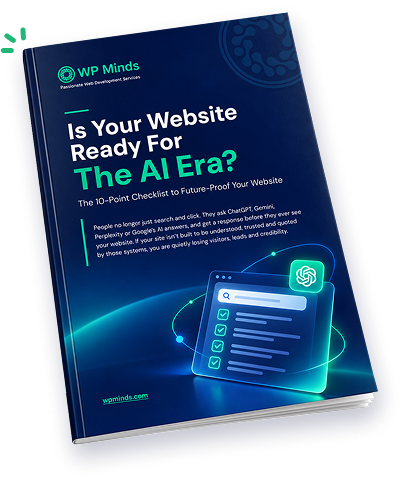
Is Your Website Ready for AI Search?
AI is changing how people discover businesses online. At WP Minds, we help businesses optimize their websites for both traditional search engines and AI-powered search, without compromising content quality or user experience.

Popular Guides
View All Guides