
How to Plan Online Course Design and Structure


When creating an online course, it may begin with a list of topics and/or videos to shoot or resources to upload. But choosing content is not all that it takes.
Another aspect to determine is how learners are to move through the material.
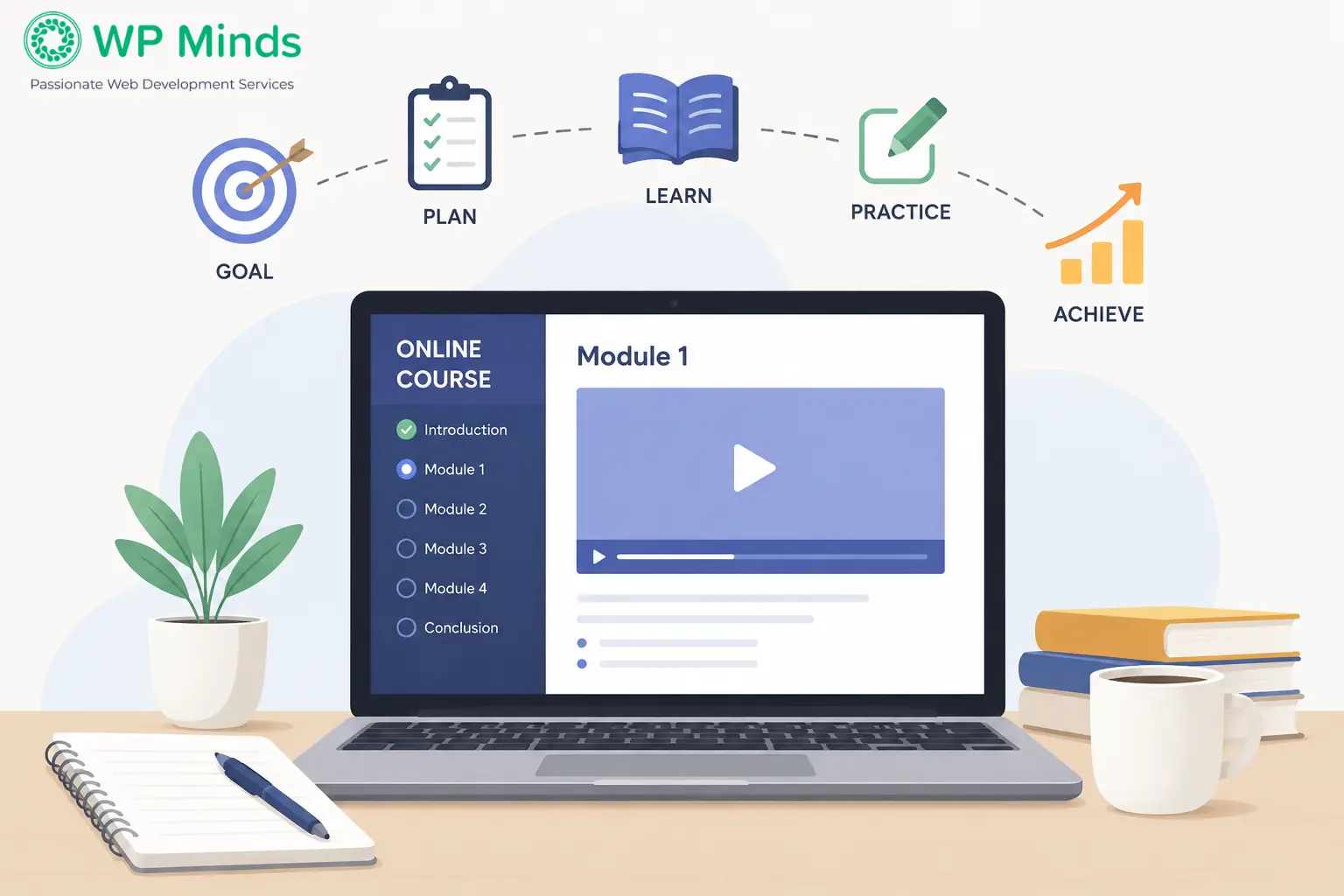
A good online course design and structure provide a logical sequence for the course. Learners are aware of where to start, what they are aiming for and how each module will assist them in making forward progress
This planning should occur before getting started with creating pages within a learning management system (LMS). A clear plan will make content creation easier and will also help you determine what features your LMS actually needs.
This is a practical approach to designing a course from initial plan to learning experience
Read More: What is LMS & How to Choose the Best One for Online Coaching
Start With the Result the Course Should Deliver
When setting out to plan individual lessons, set out what someone should be able to do when they finish the course.
Have a look at the difference between these two outcomes:
- Broad: Understand email marketing.
- Specific: Design and send a 5-email welcome series for a new subscriber.
The second outcome provides much more direction. It’s possible to determine what skills the students need, what information should be included in the course and what information is not relevant to the outcome.
Also, knowing where the learner is starting is helpful. A practical planning rule is to define both the starting point and the desired outcome before deciding which lessons belong in the course.
Ask:
- What is their knowledge level about the topic?
- What do they want to achieve?
- What is their background knowledge?
- In what areas do they most likely run into difficulties?
Someone taking an introductory course needs more background information than someone taking an advanced course. Being aware that difference is reflected in terms of depth, terminology, examples and pace of your course.
This is similar to a website strategy: When you know your audience and what you want to achieve, it becomes easier to make decisions.
Turn the Main Outcome Into Learning Objectives
Once you’ve identified the place where learners will finish, identify what they need to do on the way.
Learning objectives specify those milestones.
For instance, in a podcasting course, students might be asked to:
- Determine who you’re writing for.
- Select a specific podcast subject.
- Create a standard episode format.
- Establish simple recording equipment.
- Record and publish an episode.
Notice that these are action-based goals, not broad goals like “learn podcasting.” A well-defined objective describes something the learner should be able to do, demonstrate or complete.
Objectives can be readily linked to lessons and assignments with words like identify, compare, create, demonstrate, apply, evaluate and complete.
Learning objectives can also be used for editing. If a certain piece of content is not working to support one of the objectives, then you may want to reconsider inclusion in the course.
Create the Course Outline Before Producing Content
A course outline provides you with an overview of the course content. A useful course outline focuses first on the learning sequence, not the individual videos, slides or downloads.
In this stage, instead of individual slides, videos and downloads, concentrate on the sequence.
Assume you’re developing a course on how to start a business website. It may contain the following outline:
Module 1: Define the Website Goals
Clarify the audience, purpose and desired actions.
Module 2: Plan the Website
Choose the pages, navigation, features and content requirements.
Module 3: Prepare the Content
Develop page copy, images, calls to action and other materials.
Module 4: Build the Website
Turn the approved plan into the working website.
Module 5: Test and Launch
Review functionality, mobile usability, forms, content and launch requirements. The sequence works because one stage prepares the learner for the next.
A similar planning approach appears in a structured website development process, where strategy, planning, content, development, testing and launch each serve a different purpose.
Your online course structure should follow the natural order in which someone would apply the subject.
Use Modules to Mark Real Progress
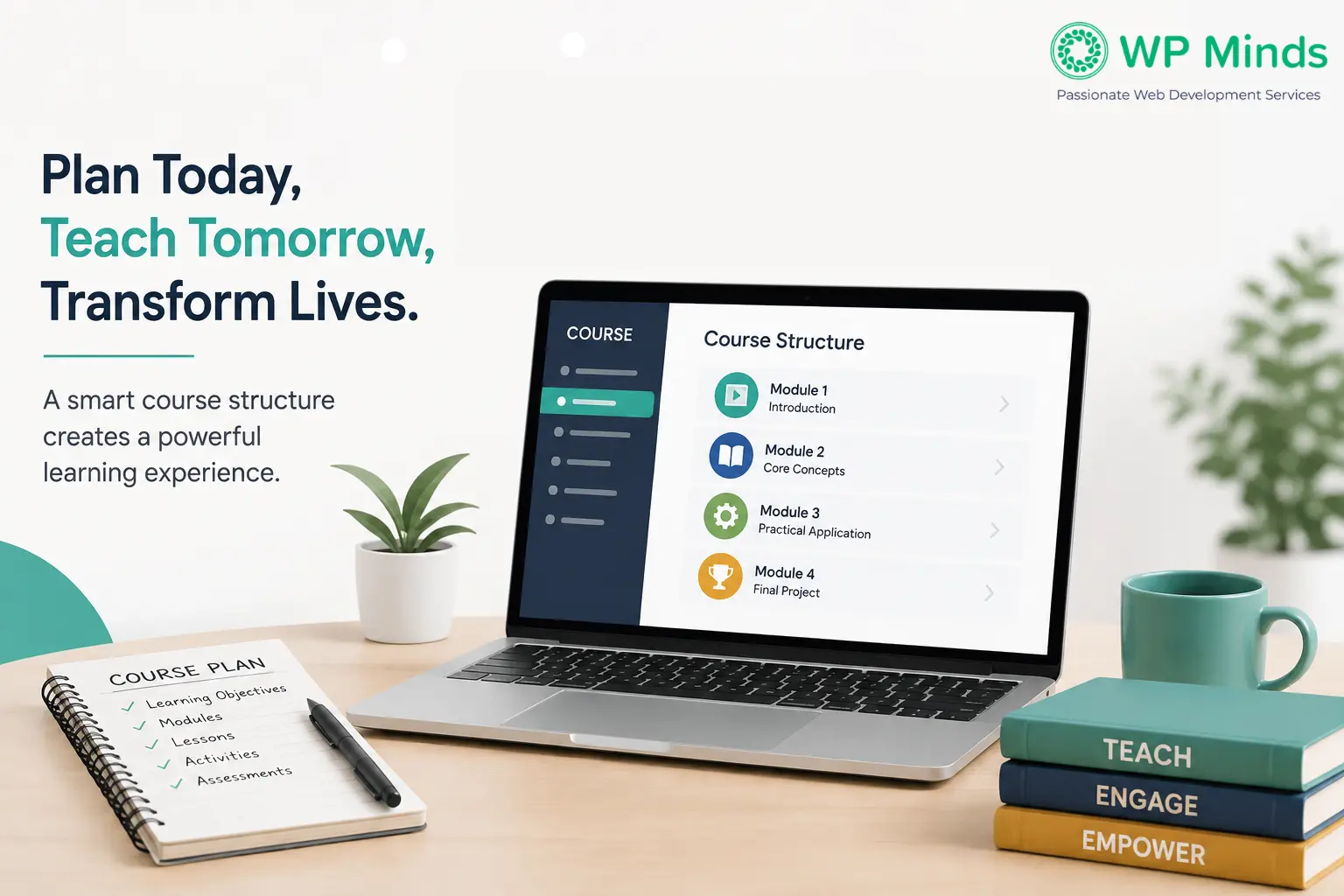
A strong online course structure uses modules as identifiable units of progress, rather than simply grouping unrelated lessons together.
Don’t make:
- Module 1: Introduction
- Module 2: More Information
- Module 3: Advanced Information
These labels provide little information to students about their growth.
Rather organize modules by milestones like:
Select your topic → Make your plan → Make your first draft version → Review the results
The learner will know what each course component will enable them to achieve.
This also facilitates the revisiting of the course. A later user can easily find his/her way through the module content without having to scan through general module names.
Break Modules Into Focused Lessons
Once the modules have been mapped, break each one down into lessons. A lesson doesn’t have to teach all things about a topic. It only has to cover what is required at that level of the course.
For example, a 60 minute class called “Everything you need to know about SEO” could be split into:
- Understanding search intent
- Choosing a primary keyword
- Structuring a page
- Writing title tags and meta descriptions
- Reviewing on-page SEO
Smaller lessons provide better stopping points for learners and allow the learner to locate specific topics more easily later on.
Not all lessons have to be long. This can take up to 5 minutes for a simple concept but may take much longer for a practical demonstration.
Determine the amount of time spent in the lesson according to its purpose.
Match Course Activities to What Learners Need to Do
All lessons do not require an assignment and all courses do not require a quiz at the end of each module.
Select activities to meet learner goals. In practice, the activity should answer a simple question: what evidence would show that the learner has achieved the objective?
A short quiz might be appropriate if only terminology needs to be recognized by students. A worksheet might be more helpful if they must devise a strategy. An assignment or project will typically provide evidence of learning if they must show a practical skill.
Activities may be:
- Templates
- Exercises
- Quizzes
- Case studies
- Practical assignments
- Reflection questions
- Final projects
The activity should be designed to support the objective and not just be available as a feature of LMS.
Research supports this approach. A 2025 study of online learning found that productive, interactive and experiential activities had a greater impact on student performance than more passive learning activities.
Source: Science Direct
Design the LMS Around the Course
Once the course structure is defined, you can determine which LMS features are actually required to deliver it. This helps avoid the common pitfall of letting the software determine how the course should be taught.
Read and understand the course specifications.
For example:
- Should learners be able to access everything at once or should it be released gradually?
- Is there an orderly progression of lessons?
- Do you need to track progress?
- Will quizzes impact completion?
- Are certificates provided?
- Do students require any downloadable resources?
- Do students need feedback from the instructor?
- Are students able to pick up where they left off?
In a good LMS, these functions should be easy to use rather than becoming another chore for the learner.
All labels on the dashboard and course page, lesson navigation, progress indicators and account area should be consistent in both terms and meaning and indicate what should be done next.
When you are creating the learning environment in WordPress, an LMS setup can integrate the course structure, enrollment process, student access and tracking of student progress within a single system.
Also Read: 10 Best Course Creation Platforms to Create and Sell Courses Online
Consider Custom Features Only When the Course Requires Them
There are many courses that would be perfectly suited to the normal functionality of the LMS. Others have requirements that standard LMS settings or plugins cannot accommodate.
Custom development may need to be done for the following scenarios:
- A custom-built student portal.
- Unusual enrollment rules
- Custom reporting
- Relational databases (CRM or third-party integrations).
- Membership-based course access
- Unique certification requirements
- Automated actions based on student progress
For such situations, custom wordpress development might be a better option.
What is key is to identify these needs in the early phases. It is difficult to add complex functionality at the end of the development process when the need arises.
Plan the Experience Before and After Enrollment
Online course design does not begin with the first lesson. Prospective learners could start on a blog post, a course page, webinar registration page, instructor profile or email campaign.
Your website content strategy should help prospective learners find the information they need before signing up.
A course page must make the following clear:
- The intended audience for the course.
- Learners will be able to…
- What is included
- The approach to teaching the course.
- Any prerequisites
- Post-enrollment activities and expectations.
This is where website conversion principles come into play. Even if the information in the course is great, the way to navigate the site, its calls to action or the checkout process can be confusing to the viewer, causing them to lose interest in the course and not fill out the sign-up form.
For WordPress based course businesses, WordPress design & development can help seamlessly integrate the public site, enrollment interface and learning environment, rather than view them as separate entities.
Test the Course From a Student’s Point of View
Set up a test account and go through all the steps prior to launch. Testing from a student account is particularly important because an administrator sees the course differently from an enrolled learner.
Don’t test the course from the WordPress admin area alone. Use a test student account and experience the course as an enrolled learner would.
Check whether:
- The Registration and payment process is correct.
- Welcome messages tell where to start.
- The order of the modules is as intended.
- Video, download and links are functional.
- Progress tracking updates correctly
- Quizzes and assignments work as you would expect.
- The course is well suited to be used on mobile devices.
- Instructions on how to complete it are clear.
This type of testing can uncover problems that may not be visible when viewing the course as an administrator.
It can also uncover usability problems, like a class that has different names or a button that directs to an unintended location.
Use Learner Feedback to Refine the Course
Course development doesn’t stop once a course is launched.
Real students might respond to the material in ways that are not anticipated.
Maybe after a class, a number of students ask the same question. Perhaps there is an important worksheet that is not being followed. Sometimes, a single module may have too many concepts.
The patterns give helpful information. When several learners struggle with the same step, the problem may be the course design rather than the learners themselves.
Do not automatically add more material. Instead, think about what the real solution to the problem is. Sometimes a better instruction, a better example or the order of the lessons is the best improvement.
The easier a course is to use, the more likely it is to be revised as a result of observed learner needs rather than assumptions.
Research involving 51 studies of MOOC learner experiences found that clear course structure, learner engagement and learner-centered design are important factors in improving the online learning experience.
Source: Science Direct
Build the Learning Path Before Building the LMS
The success of online course design starts with a clear learning path.
Start with the end in mind, then turn that outcome into learning objectives, structure those objectives into coherent learning units, and determine which lessons and activities will support students in making progress.
Once this is done, LMS decisions become simpler. You know what to monitor, what students need access to, and which features genuinely support the course.
The result is more than an organized LMS. It creates a course in which every module and learning activity has a clear purpose.
At WP Minds, we take the same approach when planning LMS projects: define the learning experience first, then determine the WordPress and LMS functionality needed to deliver it effectively.
More Related Blogs:
- How To Teach Online Using WordPress & Zoom
- 7 Must-Have LearnDash Add-Ons to Enhance Your Online Courses
- Best LMS for Selling Courses for WordPress in 2026
FAQs (Frequently Asked Questions)
How to Create an Online Course?
Select a learner and a learning outcome first. Define learning objectives, design the course outline, prepare lessons and activities, set up an LMS, upload the content and test the full student experience before launch.
How to Structure an Online Course?
Organize the material in the order learners need to understand or use it. Organize lessons into units, have each unit correspond to an important milestone and create a clear path toward a concrete goal.
What Should an Online Course Outline Include?
A course outline should include the main course outcome, learning objectives, learning modules, individual lessons, activities, assessments, the types of resources that will be used and the order of learning.
How Many Modules Should an Online Course Have?
There is no single number that is right for every course. The number of modules will vary depending on the complexity of the subject and the milestones needed to achieve the desired result. Use enough modules to break the material down logically without creating unnecessary sections.
What Makes a Good Online Course Structure?
Each module should have a clear purpose and follow a logical sequence. Learners should be able to understand how one part of the course leads to the next without having to guess why a lesson is included.
How Do You Create Learning Objectives for an Online Course?
Identify what learners should be able to do by the end of the course, then break this down into smaller skills or outcomes. Keep objectives specific by using measurable action words such as identify, create, apply, compare, demonstrate or evaluate.

Popular Guides
View All Guides