
Website Conversion Funnel: How to Turn Visitors Into Customers


Attracting traffic to your site is a very important aspect, but that does not mean you are not growing your business.
You will need to let people know what you have to offer, let them know if it solves their problem, get their faith in your business and let them know that you are confident enough to take the next step. A website conversion funnel eases the path along.
The funnel takes visitors through a sequence of smaller choices rather than a series of visits to have a customer immediately appear. They receive the information, reassurance and direction they need at each stage.
Aligning your website stages can improve traffic conversion, while identifying funnel friction points can help reduce visitor drop-off and improve conversions.
What is a Website Conversion Funnel?
A website conversion funnel is the journey visitors take from their first interaction with your website to completing a desired action.
That action could include:
- Scheduling a consultation
- Requesting a quote
- Submitting a contact form
- Joining your email list
- Downloading a resource
- Purchasing a product or service
A simple website conversion funnel can be broken into five stages:
Arrival → Understanding → Evaluation → Conversion → Follow-Up
Not every visitor will follow the same path. Someone might find a blog post through Google, visit a service page, leave your website and return several days later to schedule a consultation.
The goal isn’t to force every visitor through a fixed sequence. Instead, your website should make the next relevant step clear based on where visitors are in their decision-making process.
Your website strategy should define who your website is for, what you want visitors to achieve and the role each page plays in that journey.
Stage 1: Welcome | Make a Great First Impression
Stage 1 begins the moment a visitor lands on your website.
Visitors need to quickly understand:
- What does this business do?
- Is it relevant to me?
- Who is it for?
- Why should I keep exploring?
If those answers aren’t clear, visitors may leave before exploring further.
Common Points of Friction at This Stage
Fuzzy headlines, confusing navigation, too much information or company-focused messaging are some reasons that businesses lose visitors.
How to Improve It
Begin by stating the problem you solve and the results you deliver. The purpose of your homepage is to immediately tell your visitors what you do, who you serve and what they can do next.
That’s where Story-Based Copywriting can help with conversions. Customer-focused copy puts the visitor’s issue and anticipated end result in the middle of the message, as opposed to focusing on the business.
The goal is to give visitors enough clarity and confidence to take the next step.
Stage 2: Understanding | Guide Visitors Toward the Solution
When visitors know they’re in the right place, they want to understand how you can help solve their problem. They may explore a service page, read a blog post, check out a guide, review your process or download a resource.
Your website content strategy is very important during this stage because visitors may be at different levels of awareness.
Someone reading an educational blog may not be ready to book a consultation, while someone viewing a service page may already be evaluating their options.
Each page should have a clear purpose and guide visitors toward a relevant next step.
For example:
Blog Post → Related Guide → Service Page → Consultation
Common problems at this stage include:
- Pages contain too much unrelated information
- Internal links are missing or irrelevant
- Content does not address their queries
- CTAs don’t match the visitor’s intent
- It’s difficult to understand which service they can use
How to Improve It
Match the content to what visitors need to understand at each stage of their decision-making process.
The educational content should be used to help them understand the problem. Service pages should describe the solution. Case studies and testimonials should help to remove the uncertainty.
That’s how single pages turn into sections of a lead conversion funnel instead of individual pages.
Stage 3: Evaluation | Give Visitors Reasons to Trust You
This is where visitors understand what you have to offer, but now they’re asking whether your business is the right choice.
Their questions become more specific:
- Will you be able to help me?
- Why should I choose you?
- What makes you different from the competition?
- What will it be like to work with you?
Trust is essential at this stage.
What do visitors need during the evaluation stage?
- Testimonials and reviews
- Case studies or examples
- Relevant experience
- Clear service descriptions
- A clear explanation of your process
- Frequently asked questions
- Responses to typical questions
Don’t expect visitors to take your claims at face value. Give them evidence and enough information to understand what it will be like to work with you.
Your copy should also address common objections. If prospective clients frequently ask what you do, how much it costs, what the process involves or what happens after they get in touch, answer those questions before they leave.
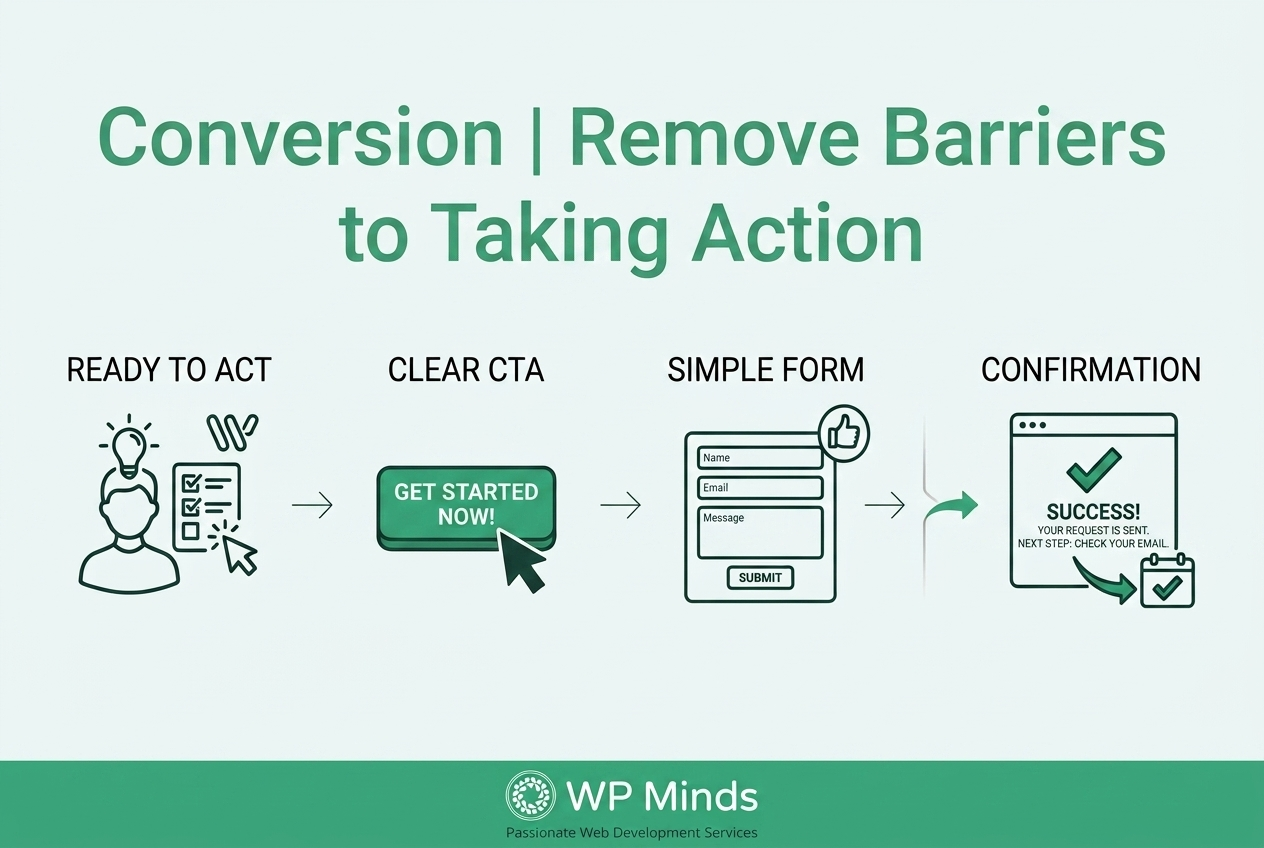
Stage 4: Conversion | Remove Barriers to Taking Action
Visitors can move through the first three stages and still drop off when it’s time to take action. This makes the conversion stage one of the most important areas to optimize. When visitors are ready to act, the process should be as simple as possible.
A research found that the average online shopping cart abandonment rate is 70.22%, showing how easily users can drop off before completing a purchase.
Source: Baymard Institute
Common Conversion Friction
Problems often include:
- Long contact forms
- Forms with too many fields
- Any buttons that are general in nature, like “Submit”.
- Multiple competing CTAs
- Difficult mobile forms
- Unclear instructions
- No explanation of what happens next
Suppose a person has been mulling over for a few minutes and has decided to reach out to your business. You don’t want to add work needlessly!
How to Improve the Conversion Stage
Use specific calls to action that clearly tell visitors what to do next.
For example:
- Make an appointment for a Strategy Call
- Request a Website Audit
- Get a Project Quote
- Take a few moments to read the Free Guide.
Focus forms on information you really need to start the conversation.
The next step should also be explained to guests as to what occurs when they fill out the form. A brief statement like: ‘We will look at your request and get back to you to talk about what happens next’ will alleviate uncertainty.
At the end of the day, the goal of any website conversion strategy is to minimize friction and guide visitors towards taking action with greater confidence.
Also Read: Landing Page Design Best Practices That Actually Convert
Stage 5: Follow-Up | Keep Helping After the First Conversion
Not all conversions equate to a customer. Someone who clicks on a guide or registers on your email list has become a “lead”. However, they might require additional information before making a purchase.
Follow up may involve:
- A useful confirmation page
- A welcome email
- A series of informative emails
- A related case study
- Additional resources
- An invitation to schedule a consultation
This is particularly useful for services where people don’t make a decision right away. The objective is to continue helping qualified prospects until they are ready for the next step.
Conversion Funnel Analysis: Find Where Visitors Drop Off
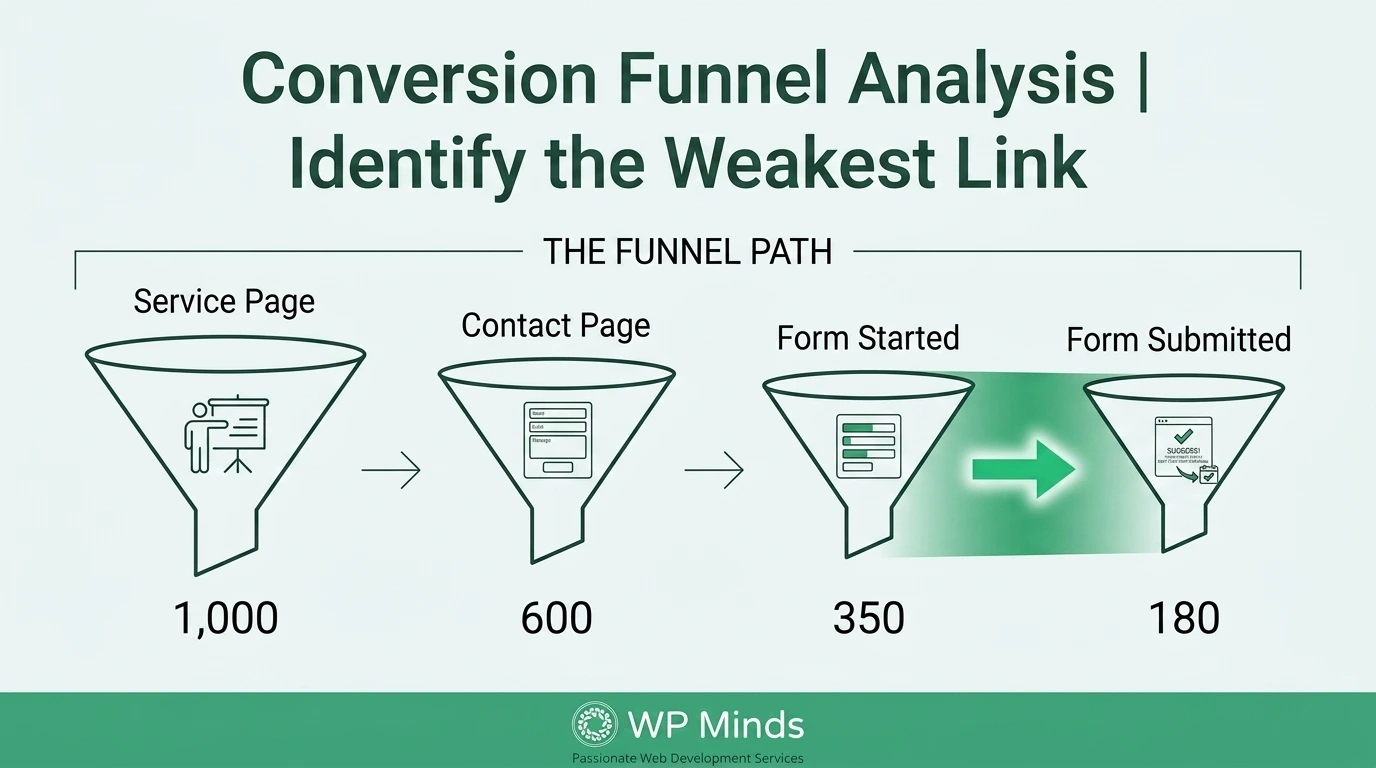
If you don’t know where you’re losing your funnel, then you can’t improve it. The conversion funnel analysis is about analyzing visitor flow from one important step to another important step.
For example:
Service Page -> Contact Page -> Form Started Page -> Form Submitted Page
If lots of people view a service page but few view a contact page, what does that mean? It could be your offer, CTA, messaging or lack of trust.
If many visitors reach the contact page but few start or complete the form, the form itself may be creating friction.
Review important actions such as:
- Visitors to important landing and service pages
- CTA clicks
- Movement between pages
- Form starts
- Form completions
- Exit points
- Completed conversions
Don’t redesign all of a sudden; look for the weakest transition and begin there.
Useful Read: Website Redesign Strategy: Improve SEO, UX & Conversions
How to Approach Conversion Funnel Optimization
Optimization of a conversion funnel ought not to be a once-off website project. The first step is to understand the current website visitor journey.
For each key page ask the following questions:
- Who is your ideal audience?
- What is it they should be learning here?
- What should be the goal of this page?
- What could stop them from going on?
- What do they need to do now?
The questions frequently lead to pages that are unclear about their intended message, lack information or have conflicting calls to action. Then the messaging, page layout, calls-to-action, forms, navigation and trust builders may be improved and tested.
A Report analyzed more than 41,000 landing pages, 464 million visitors and 57 million conversions to identify what influences landing page conversion rates.
Source: Unbounce
When you’re not sure where your current funnel is failing, Website Consulting Services can offer a fresh viewpoint on your website strategy, messaging, user experience and conversion path.
Read More: Conversion Rate Optimization Checklist – Best Practices
Is Your Website Losing Visitors Before They Convert?
Conclusion
The trick to a successful website conversion funnel is not to force visitors into a sale. It makes the decision-making process easier.
The first impression that visitors get should be clear. They require information during the exploration process that is useful to them. When assessing your business, they require evidence. When they are ready to do something, they need something simple to do next.
If your strategy, content, messaging, trust signals and CTAs address those needs, your website becomes more than a collection of pages. It becomes a connected system that guides the right visitors toward becoming customers.
To begin with, draw out your current funnel and identify where someone is likely to fall out of the equation. Then work on that stage before going to the next. Making small changes at every touchpoint of the visitor can help to develop an easier path to conversion.
At WP Minds, we help businesses improve their website strategy, messaging, user experience and conversion paths to turn more visitors into customers.
More Related Blog
- 10 Best Conversion Rate Optimization Tools
- Conversion Rate Optimization Audit – Comprehensive Guide
- How to Create High-Converting Landing Pages
- 10 Ways to Maximize Website Mobile Conversion Rate
FAQs (Frequently Asked Questions)
How to create a Multi-Step conversion funnel?
Begin with one key conversion objective, like booking an appointment. In reverse, figure out what visitors must have done before they were ready for that move. Design each page or content for each step, link them together with strong calls to action and track the flow of traffic between the steps
What Is a Good Funnel Conversion Rate?
The ideal funnel conversion rate can vary from one website to another. Depending on industry, traffic source, audience, offer, price and conversion goal, results differ. Instead, it’s best to set the baseline conversion rate for your site, find the highest drop-off points in the funnel and then track progress over time.
What is a Website Conversion Funnel?
How to Create a Website Conversion Funnel?
Identify the conversion objective and target audience. Next, draw in the circles how visitors are coming and what they’re asking at each point, what pages should answer those questions and what should move them to the next one. Find and address weak points using analytics and conversion tracking.
What are visitors doing to get lost before converting?
They may leave if your message is not clear, the page is not what they are looking for, they don’t have enough information, they can’t be trusted, the CTA is hard to find or it’s too difficult to perform the action they need. It can be helpful to find out where the drop-off is happening in your conversion funnel in order to direct your attention to the correct problem.

Popular Guides
View All Guides