

Content Marketing For Law Firms – Definitive Guide


Content marketing for law firms involves creating user-centric content in clear, easy-to-understand language and disseminating it through various channels.
It involves using various strategies to create content, using this content properly for optimisation and growth, and converting viewers into long-term clients.
Most attorneys publish a few blogs, post updates on LinkedIn, or hire someone to “do SEO.” But few law firms have a structured content system that actually builds visibility, trust, and consistent leads.
The difference?
They focus on posting instead of publishing with purpose.
Your content should make potential clients think,
“This firm understands my problem and can help me solve it.”
In this guide, you’ll learn all about content marketing for law firms.
Let’s dive in!
5 Pillars Of Content Marketing
At its heart, content marketing for law firms means creating helpful, compliant, and trustworthy information that answers your clients’ legal queries.
It’s built around five pillars
| Pillar | What It Means for Law Firms |
|---|---|
| Audience | Define who you’re speaking to, not just “people,” but “families going through divorce,” or “business owners facing contract disputes.” |
| Content | Create materials that educate and empower your audience. |
| Publishing Platforms | Share your content where your audience spends time: your website, LinkedIn, YouTube, or Google Business Profile. |
| SEO | Optimise for search intent, especially local keywords. |
| Performance Tracking | Measure ROI, conversions, and engagement |
What is Content Marketing For Law Firms?
Whatever the type of marketing, the goal is to get more leads and close more clients.
Content marketing for lawyers means creating and promoting content that answers potential clients’ legal questions while positioning your firm as a credible expert.
It combines:
- EEAT (Experience, Expertise, Authoritativeness, Trustworthiness)
- YMYL (Your Money or Your Life) content standards
- Local SEO for visibility in your region
- Conversion-focused messaging that builds client confidence
In short, it’s about making legal expertise approachable, accessible, and findable online.
Read the complete guide on how to write content for a law firm website.
Importance of Content Marketing For Law Firms
The legal industry is built on trust, and trust begins with clarity, education, and visibility
- 96% of people search on Google for a nearby legal service provider.
- Service businesses with blogs on their website receive 67% more leads and traffic than websites without blogs and less content.
- More than 50% of the law firms plan to use content marketing as an important part of their marketing
Why Most Law Firm Content Fails
Most law firms struggle with content because they treat it like a task, not a strategy.
Here’s what typically goes wrong
- Legal jargon-filled articles do not use complex legal words; make them simple and understandable for readers.
- Irregular publishing – random publishing or publishing once in a while.
- No repurposing or content updates.
- Focusing on keywords over clarity – writing for search engines only.
- “Contact Us” as the only call to action – embed pin maps, and multiple contact options.
Benefits of Content Marketing for Lawyers
Creating and promoting content for a law firm is perilous.
The legal or law niche faces more compliance and content challenges than any other industry, which is why creating content and marketing for law firms is challenging.
Firms investing in educational content generate 54% more qualified leads than those relying solely on ads. Here are 5 benefits of investing in law firm marketing
| Benefit | Description |
| Increased Visibility | Helps Law firms rank for high-intent search queries like “best family lawyer near me.” |
| Builds Authority | Positions your firm as an expert through valuable, consistent content. |
| Improves Client Trust | People prefer firms that explain the law clearly and transparently. |
| Boosts Conversions | Strong content nurtures visitors into leads before they ever call your office. |
| Long-Term ROI | Unlike ads, well-optimized content keeps generating traffic for years. |
How to Research Local Search Intent for Law Firms
Local SEO is where most law firms win or lose visibility. To understand search intent:
- Use Google’s “People Also Ask” and “Related Searches” for regional queries.
- Analyse competitors, see what top-ranking law firms in your area are publishing.
- Check Google Business Profile insights to see what search terms bring traffic.
- Combine location plus practice keywords, e.g., “divorce lawyer Austin, TX.”
- Use tools like Ahrefs, Semrush, or Google Keyword Planner to filter by city, state, or zip code.
7 Steps Content Marketing Strategy for Law Firms
It’s hard to know where to start, but it’s easy if you know the definitive pillar.
Content marketing for lawyers can be successfully done in 7 steps.
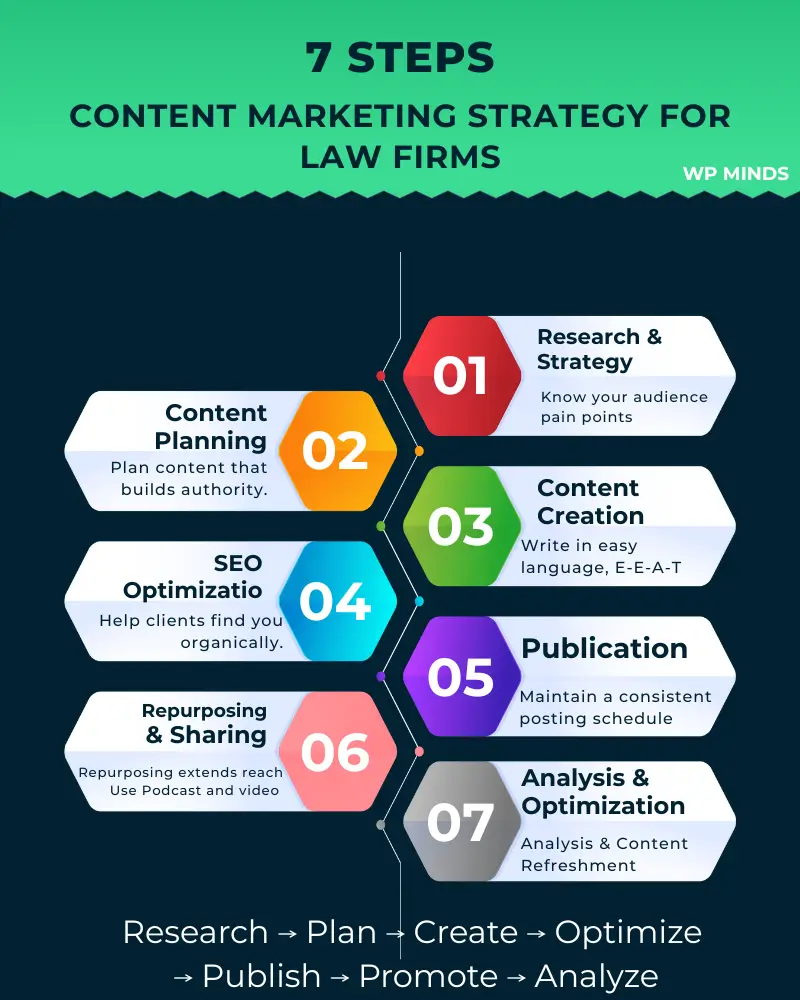
1. Research & Strategy
Know your audience and their pain points by defining your audience, practice areas, and client journey. Identify:
- Their problems and fears
- Search terms they use
- What content competitors publish
2. Content Planning
Map content around client FAQs and high-intent search terms. Plan your topics around client intent,“how to file for divorce,” “what to do after a car accident,” “how to write a will.”
Plan 3 to 6 months of content and stick to a publishing rhythm.
3. Content Creation
Produce easy-to-read 10th-grade, legally accurate, client-focused content. If you go into legal jargon, the user gets confused or is unable to understand, and switches to the next option.
4. SEO Optimisation
Use clear titles, metadata, and internal links to rank better. Every article should have:
- Local schema for service areas
- Keywords in the title and the first 100 words
- Optimised meta description
- Internal links to related pages
5. Publication
Share consistently across your blog, LinkedIn, Social media platform, and Google Business Profile, answer queries, and reply to reviews in a timely manner.
6. Repurposing
Leverage social channels, generate video content, podcasts, and repurpose articles into short-form posts, email newsletters, and resource downloads. Turn one strong piece into multiple touchpoints:
- Turn a blog into a video explainer.
- Use quotes for social posts.
- Convert a FAQ section into an email series.
- Compile a few blogs into an eBook or downloadable guide.
Repurposing extends reach without recreating content from scratch.
7. Analysis & Content Refreshment
Track which content converts with Google Analytics and Search Console, then refine it. Law and SEO both evolve your content should too.
Every 6–12 months:
- Add fresh visuals or recent testimonials.
- Refreshing signals Google that your content is relevant
- Update case laws, stats, or internal links.
- Rewrite outdated CTAs or headlines.
Key Elements of Content
The 5 key elements to produce useful content are
- Purpose & Audience – Know who you’re writing for and why.
- Structure & Readability – Keep it skimmable with headings, bullets, and summaries.
- Relevance & Value – Solve real problems with clarity and insight.
- SEO Optimisation – Integrate relevant legal keywords and schema markup.
- Engagement & CTA – Always guide readers toward action or contact.
What’s Included in Law Firm Content Marketing
Comprehensive content marketing for law firms includes
- Website content
- SEO & blog strategy
- Email campaigns
- Social media content
- Downloadable resources (guides, PDFs, checklists)
- Paid promotions
- Content publishing, repurposing, and refresh cycles
All these types of marketing work together to build credibility and attract consistent leads.
Types of Content That Work For Law Firms
You can not engage users with just one type of content; variety is key here.
It’s not just about writing blog posts; it’s creating a full ecosystem of trust and authority. An effective law firm content branding includes
- Blog posts – Address client pain points and recent legal updates.
- Videos and infographics – Simplify complex laws visually.
- Podcasts and webinars – Share discussions with industry peers.
- Downloadable guides – Provide valuable PDFs, checklists, templates

Content Marketing Tools For Law Firms
These are the best tools for law firm content marketing
| Tool | Purpose |
|---|---|
| Semrush / Ahrefs | Keyword and competitor analysis |
| SurferSEO / Rank Math | Optimize for search and readability |
| Grammarly / Hemingway | Simplify and polish your writing |
| Canva / Visme | Create infographics and branded visuals |
| HubSpot / Mailchimp | Manage email marketing and nurturing |
| Google Analytics / Search Console | Measure performance and track ROI |
Conclusion:
Wrapping up, content is the ultimate king for law firms.
Where a single misplaced data, wrongly handled content, or unlicensed images can cost you harsh penalties.
Rightful content marketing is a valuable service you can hire.
Here we can help
- Content creation service for law firms
- Website development for lawyers
Get in touch! Book a free consultation! Let’s fetch the right content for you.
FAQS
What does content marketing include for lawyers?
It includes blogs, SEO, social media, email newsletters, and downloadable legal resources to educate and attract potential clients.
Why is content marketing important for law firms?
It builds authority, improves visibility, and generates leads without depending solely on ads
How often should law firms publish content?
Consistency is key—at least 2–4 posts per month with regular updates across platforms.
Is content marketing compliant with legal advertising rules?
Yes, as long as the content is factual, non-deceptive, and follows state bar guidelines.
How can law firms measure ROI from content marketing?
Track metrics such as website traffic, organic leads, conversion rate, and ranking improvements using analytics tools.

Popular Guides
View All Guides