
Content Brief Template for Websites


Good website content starts with a clear brief. Before writing begins, the writer should understand the audience, the services being promoted, the SEO focus, and what the reader should do next. Without that direction, homepages, service pages, and blog posts can easily become unclear or unfocused.
A content brief connects your website strategy, audience needs, SEO goals and desired reader actions. It helps you create focused content for blog posts, service pages, landing pages, location pages and resource guides.
Read More: Creative Content: 5 Easy Ways to Create Content For Your Website
What Is a Content Brief?
A content brief is a planning document that helps you create a particular type of content. It gives the writer, SEO team, designer and business owner the same direction.
A good content brief usually includes:
- Page type and topic
- Target audience
- Search intent
- Primary and supporting keywords
- Suggested outline
- Internal and external links
- Tone and writing guidance
- Call to action
Consider it a roadmap. It doesn’t write the content for you, but it guides the writer on where the content should proceed.
For example, When asked to draft a service page for “website maintenance,” a writer may write about updates, backups and support. But if the content brief indicates the page is for business owners tired of plugin troubles, poor page loading and security concerns, the final content is more focused and useful.
That is the real value of a content brief. It turns a broad topic into a focused website asset.
Why a Content Brief Matters for Website Content
Website content has to do more than sound good. It should support visibility, trust and conversions.
Without a shared brief, content can become broad, repetitive, inconsistent or disconnected from the website’s goals. A brief ensures each page has a defined audience, purpose, keyword, internal linking opportunity and next step.
A content brief helps prevent these gaps. It gives every page a clear purpose. It also helps your team answer important questions before writing:
- Who is this content for?
- What problem should it solve?
- What keyword should it target?
- What should the reader understand by the end?
- What internal page should the reader visit next?
- What action should the content encourage?
When these questions are answered early, the content becomes easier to write, easier to review and more useful for the reader.
Also Read: Website Content Development: A Complete Guide
How a Content Brief Supports SEO Optimized Content
A content brief builds SEO into the planning stage instead of adding keywords after writing. It identifies the focus keyword, supporting terms, search intent, headings, internal links, external sources and relevant questions.
For instance, a search for “content brief template” indicates a desire for a practical format. Addressing reader intent with actionable content ensures the brief’s utility and effectiveness.
What to Include in a Content Brief Template for Websites
A website content brief does not need to be complicated. It just needs to be clear and practical.
Below is a simple structure you can use for blogs, service pages, landing pages and website guides.
1. Page Type and Topic
Start by defining what type of content you are creating.
Is it a blog post? A service page? A landing page? A homepage section? A location page? A product page?
Each page type has a different goal, such as:
- A blog post may educate and attract organic traffic.
- A service page may explain your offer and encourage inquiries.
- A landing page may support a campaign and drive sign-ups.
- A homepage section may guide visitors to the right service.
- A location page may support local SEO visibility.
Example:
Topic Title: Content Brief Template for Websites
Page Type: Blog post
Target Service: Content Creation Services and Website Content Strategy
Primary Goal: Educate readers and introduce content planning support
Defining the page type helps the writer understand how the content should be approached.
2. Content Goal
Every page should have a clear goal. A common mistake is creating content only because a keyword has search volume. Keyword research is useful, but it should connect to a business goal.
For this article, the goal is not just to explain what a content brief is. The goal is to help business owners, marketers and website teams understand how a brief can improve website content planning.
Example content goals:
- Teach readers how to create a content brief
- Show how a brief improves website content structure
- Help readers plan SEO focused website content
- Introduce WP Minds’ content creation and website strategy support
- Encourage readers to review their current content process
When the goal is clear, the writer knows what to emphasize.
3. Target Audience
The target audience section explains who the content is for.
This matters because the same topic can be written in different ways depending on the reader.
For example, a content brief article for SEO professionals may include SERP analysis, entities, NLP terms and competitor gap analysis. But a content brief article for small business owners should be simpler, clearer and more practical.
For this topic, the audience may include:
- Small business owners planning a new website
- Coaches, consultants and service providers
- Marketing teams managing website content
- Agencies creating content for clients
- Website owners improving old pages
- Businesses investing in content creation services
A useful brief should also include the audience’s pain points.
Example:
The reader may struggle with unclear website messaging, inconsistent page structure, weak SEO performance or too many content revisions. This helps the writer speak directly to what the reader is experiencing.
4. Search Intent
Search intent explains why someone is searching for the keyword. For the focus keyword content brief, the intent is mostly informational. The reader wants to understand what a content brief is and how to create one.
But for the topic “Content Brief Template for Websites,” the intent is more practical. The reader likely wants a process, template or example they can use.
A good content brief should identify this clearly.
Example:
Primary Search Intent: Informational
Secondary Search Intent: Practical/template-based
Reader Needs: A clear explanation, a usable structure and examples
Business Opportunity: Connect content planning with website content strategy and content creation services
This makes the content more helpful because it gives the reader what they came for.
5. Focus Keyword and Supporting Keywords
The focus keyword is the main keyword the content should target. Supporting keywords help expand the topic and make the content more complete.
Example:
Focus Keyword: content brief
LSI Keywords:
- SEO optimized content
- content outline
- SEO content brief template
- Content brief example
- writing guide
- content structure
These keywords should be included naturally in headings, paragraphs, examples and FAQs.
A practical tip is to assign keywords to sections instead of forcing them everywhere. For example, use “content outline” in the section about structure, “writing guide” in the section about tone and “content brief example” in the sample section.
This keeps the article natural while still supporting SEO.
6. Content Outline
A content outline gives the writer the structure of the page before writing starts.
This is one of the most useful parts of a content brief because it prevents the article from becoming scattered.
A good outline should feel like a natural journey. Start with the basic explanation, then explain why it matters, then show how to create one and finally provide examples and next steps.
7. Website Specific Notes
This is where many content briefs become more valuable.
Instead of only giving the writer keywords and headings, include notes that relate to the actual website.
For example:
- Which service page should this blog link to?
- Which audience segment should the page speak to?
- Which offer should be mentioned?
- Which existing page should this content support?
- Should the page include FAQs?
- Should the CTA point to a consultation, contact form or service page?
For a website content strategy, this section is important because every new page should support the larger website.
Example:
If you are writing a blog about website planning, it should naturally link to your website strategy guide.
This helps readers continue their journey instead of reaching a dead end.
8. Tone and Writing Guide
A writing guide helps the writer match your brand voice.
This section can include tone, reading level, sentence style and words to use or avoid.
For a WP Minds style article, the tone should be:
- Clear
- Practical
- Helpful
- Professional
- Easy to understand
- Friendly but not casual
- Service focused without sounding too sales heavy
This helps keep the content consistent across the website.
9. Internal and External Links
Links should be planned before writing, not added randomly at the end.
Internal links help connect your content to your services, guides and related resources. They also help search engines understand your site structure.
External links enhance credibility by referencing reliable sources. Useful resources like Content Harmony, Jasper or Siteimprove detail content briefs and best practices, benefiting readers rather than merely serving SEO purposes.
The key is to use links where they help the reader, not just for SEO.
10. Call to Action (CTA)
A call to action explains what the reader should do after reading the content. It should support the page’s main goal and guide the reader toward a relevant next step.
The CTA may encourage readers to:
- Contact your business
- Book a consultation
- Request a quote
- Explore a related service
- Download a resource
- Read a supporting guide
- Subscribe to your newsletter
Choose one primary CTA and make it clear, relevant, and easy to complete. Avoid adding several competing actions that may confuse the reader.
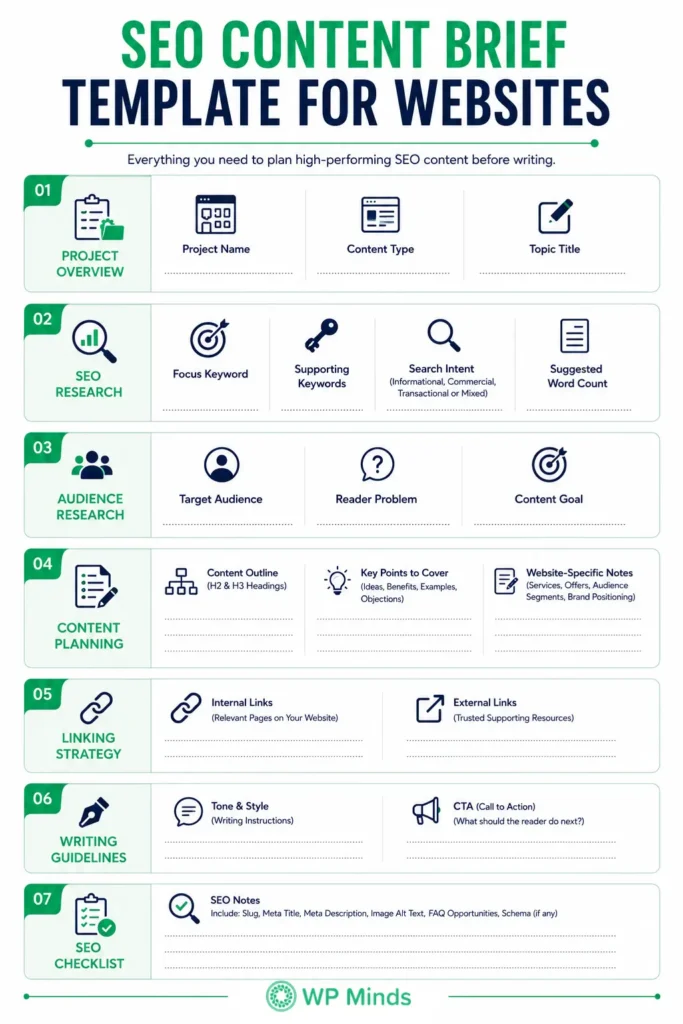
SEO Content Brief Template for Websites
Here is a practical SEO content brief template you can use when planning website content.
Final Thoughts
A content brief is one of the most useful tools for planning website content. It helps you move from a rough topic idea to a clear writing plan.
For website projects, this matters because every page should have a purpose. Your content should support SEO, guide the reader, connect to your services and help visitors take the next step.
If your website content feels scattered, unclear or difficult to plan, WP Minds can help you create a stronger content process. Our Content Creation Services can help you plan, structure and write content that supports your business goals. You can also explore our website consulting services or website strategy guide if you want to build a clearer content direction before updating your website.
Ready to create website content with a stronger strategy behind it? Contact WP Minds to plan content that is clear, useful and built to support growth
More Related Blogs:
- How To Write Content For A Website And The Best Ways To Create It
- Website Content Strategy: 14 Questions to Build Your Plan
- Website Content Workflow for Agencies
FAQ’s
What are the 5 C's of content?
The 5 C’s of content are clarity, consistency, credibility, connection and conversion. These help make content easy to understand, aligned with your brand, trustworthy, relevant to the reader and focused on a clear next step.
How to make a content brief?
To make a content brief, define the topic, audience, focus keyword, search intent, content goal, outline, key points, internal links, tone and CTA. This gives the writer a clear direction before writing begins.
What is the difference between a content brief and a creative brief?
A content brief is mainly used for written content such as blog posts, website pages, landing pages and SEO content. It includes keywords, search intent, headings, audience details and writing guidance.
A creative brief is broader. It is often used for design, branding, advertising, video or campaign work. It may include visual direction, brand concepts, design requirements and campaign goals.
How to create a standard SEO content brief?
A standard SEO content brief should include the focus keyword, supporting keywords, search intent, audience, content goal, suggested headings, internal links, FAQs, meta details and CTA. It should help the writer create useful content, not just keyword focused content
How to write brief outline SEO content?
To write a brief SEO content outline, start with the main topic and focus keyword, then organize the page into clear H2 and H3 sections. The outline should move from explaining the topic to giving practical guidance, examples, FAQs and a clear CTA.

Popular Guides
View All Guides