

How To Build A Lead Generation Website


This is a complete guide on how to build a lead generation website and everything that is involved in the process.
In this post we’ll go over:
- What is a lead generation website
- How to build a lead generation website
- Benefits of a lead generation website
- Different types of lead generators
- Tools for lead generation system
- Lead generation website examples
There are different types of websites but the main purpose of a website is to bring traffic, generate leads and ultimately sales. A lead generation website ticks all the boxes.
If you are skeptical about whether or not your business needs a lead generation website, this post is for you.
Want to learn more about turning your website into a lead-generating machine? Listen to Ryan Meghdies share practical tips on improving website conversions and making it easier for visitors to become leads.
What is a lead generation website
A lead generation website can be summed up as an extensive brochure website with all the essential features you need for lead generation and sales.
A lead generation website has the following must have website pages:
- Homepage
- About page
- Contact page
- Product/service page
- Blog page
- Legal page
- Testimonials page
Following are the essential features of a lead generation website:
- Regular website content (Blog)
- Lead generator
- Optin pop-up
Benefits of a lead generation website
The main goal of a lead generation website is to generate leads and convert them into sales which is also its biggest benefit.
Following are a few more benefits:
- High quality leads: A lead generation website will generate high quality and relevant leads for your business.
- Increased conversion rate: The visitors on your site have a higher chance of conversion. This can either mean subscribing to your email list or converting into a long term client.
- Email list: Your email list is your biggest online asset. A lead generation website can help you in expanding this list.
- Content promotion: Once you have an email list, these people are genuinely interested in your product or service and therefore, you can send them regular updates and recently published content as they become your regular readers.
- Builds a connection: When you provide someone with free valuable information, you build a connection with them and your conversion rate increases.
Different types of lead generators
The purpose of a lead generator is to have enough value that a visitor is ready to exchange their email ID for that.
Lead generators are of many types, a few common ones are:
- Downloadable PDF
- eBook
- Free webinar
- Free course
- Quiz
- Free content sample
- Trial
- Free audit
- Checklist
- Cheat Sheet
- Free podcast
- Free templates
- Complimentary event
- Free tool
- Anything that can be valuable for your targeted audience
You can have a different lead magnet for individual landing pages that may resonate with your audience and increase the conversion rate.
Keep trying and testing different lead generators to see which one works for you and what doesn’t.
How to Build a Lead Generation Website
A lead generation website has everything that a regular website has, the same pages, contact information, product/service pages and so on.
We have also talked about the important features and pages that a lead generation website must have. The only difference between a regular website and a lead generation website is a lead generation system.
But first let’s go over how to develop a lead generation website using WordPress.
Step 1: Find a Domain Name
The address of your website is called domain name. Be careful with your choice earlier, as it will be hard to change it later in future.
Step 2: Register Your Domain Name
Getting the domain registered is the only thing left to do after that. The post goes into great depth about how to register your domain.
Step 3: Purchase Hosting
There are hundreds of web hosting providers out there but it is crucial to find the right one. Your domain is like your house and hosting is the land where you can store it and access it from anywhere in the world.
Step 4: Start Creating Your Website
These steps need to be carefully thought out and carried out. This can be hired out or if you’re good at it, you can do it yourself. Starting with downloading and customizing a theme you like is the first thing you need to do.
Step 5: Website Content
Once you have your website grey structure ready, now you need powerful content and images to make your message clear. Spend time on creating content for different pages.
Step 6: Configure Plugins
In the same way that apps improve the functionality of your website, plugins do the same thing. There is a plugin for almost everything you need. Install and configure these plugins with your website. There is no right or wrong number of plugins but only add the ones you need.
These were the basic steps of how to build a website and how much time does it take to build a coaching website.
As discussed above, the major difference between a regular website is the lead generation system, so let’s get to that.
Lead generation system
A lead generation system is the process of attracting and converting your potential clients by offering something valuable at no cost to them at all (in exchange of their email).
You grow the email list to help you convert them into full-time clients in the future by sending them various offers and useful information.
Here’s an example of a lead generator:
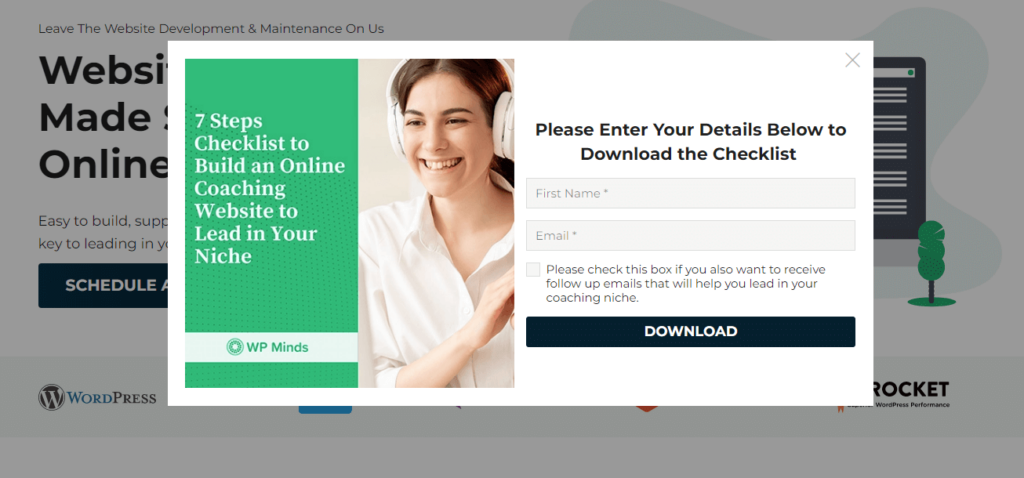
It is recommended that you should clarify and have one valuable resource that has enough value that your prospects can give you their email ID in exchange for that so you can contact them again and again.
Also having a pop-up is also recommended as it said to increase the conversion ratio by 60%.
It takes so much time, energy and effort to bring someone to your website. Not having a lead generation system can make your efforts go in vain as you lose the visitors without capturing their contact information.
Having an email list is important for any business and will always pay off in the future. It is one of the assets you have online.
How to follow up with your leads
Once you have their email address, you can stay in touch with them with your content, offer and services because these are the people who are genuinely interested in your business and the chances of converting them into full-time customers are a lot greater compared to a cold email outreach.
Here’s how you can stay in touch with those who have subscribed to your email newsletter.
Best practice is to send 5-7 emails with good CTAs immediately after they sign up.
Then, you may maintain in touch with them on a regular basis and keep your leads fresh.
There are multiple ways to do that.
- Weekly or a monthly newsletter (relevant to the niche)
- Regular discounted offers
- Tips and tricks relevant to their interest
- News/updates
It is ideal to create a mix of all of the above. Communicate with leads weekly, biweekly or monthly Consistency is essential regardless of choice.
Tools for a lead generation system
You require two main tools for this system to work.
- Optin form plugins
- Email software
Here are the top three recommendations for these.
Optin form plugins
Putting up interesting opt-in forms on your website is the best way to get more people to sign up for your email list. It is an email sign-up form that we used to capture the information of potential leads, along with their consent for your marketing needs.
Types of WordPress Opt-in form plugins
There are many sorts of opt-ins, but these are the most common ones:
- Pop-ups: It is one of the most popular types of opt-in. It displays when a visitor lands on a page.
- Sidebars: Sidebar opt-ins are usually added to sidebars using widgets.
- In post: These opt-ins are displayed within the content of a page or post. It is effective for long-form blog articles where you can grab the visitor’s attention
- Slide-ins: Slide-in opt-ins are usually presented a few seconds after the page has loaded, from the top, bottom, left or right of the screen..
- Bars: Bar opt-in displays at the top or bottom of a page in a fixed position. These are effective for a small amount of text.
Following are the most effective Optin form plugins
1. Optin Forms
Opt-in Forms plugin helps you to create great looking opt-in forms. You may construct the forms without learning HTML or CSS.

Following are the features ofOpt-in Forms:
- Customizable
- Easy to change text, fonts and font sizes
- Option to change colours
- Includes upto 5 unique form designs
- Works with multiple email solutions, including AWeber and MailChimp
2. OptinMonster
OptinMonster is the most powerful lead capture software used by marketing specialists.
It lets you build attractive pop-up campaigns, email subscription forms, sticky announcement bars, spin-a-wheel opt-in forms and other kinds of interactive pop-ups for your site in minutes.

Features of OptinMonster include:
- Different campaign types
- Mobile-friendly popups
- Opt-in targeting features
- Compatible with almost all email softwares
3. Convert Pro
Convert Pro is also a list-building plugin for WordPress that makes the process of generating leads smoother. It has a vast template library and also offers the option to create unique designs.
Convert Pro plugin has a drag & drop editor, mobile responsive features and a plugin that won’t affect the speed of your site.

Features:
- Drag and drop customization
- Cloud technology
- Advanced triggers to target the right people at the right time
- Filters to personalize your message
- Real-time analytics
Email Software
Email softwares play a very vital role in your marketing effort. If someone signs up for your email, you should keep in touch with them often. Email marketing software lets you make email list parts, email campaigns, newsletter schedules and a lot more automatically.
The following are the top 3 email marketing software recommended by experts.
1. Mailchimp
Mailchimp is one of the best email marketing software as it has all the features that you may need, without being it overly complicated. You can:
- Schedule campaigns
- Do A/B testing
- Easy integration
- Open, click-through and unsubscribe rate reports
- Easy-to-use email editor

It is the perfect tool for any business looking for a simple way to automate their email campaigns.
2. ActiveCampaign
ActiveCampaign is the best email marketing software for automation. It has hundreds of pre-built campaigns that help you personalize them for every subscriber.
- Easy to use and intuitive interface
- Built-in campaigns
- Easy to customize
- Resources for every step
- Fast customer support
- Integrations with almost any software out there

ActiveCampaign helps you build customized automations to increase engagement with subscribers. It includes sales automations as well.
3. Aweber
AWeber is a great email marketing platform. It includes
- Drag-and-drop email editor
- AI-powered email template designer
- Built-in templates
- Automations
- A/B testing
- Segmentation
- Easy integrations
- Resources/blogs for easy guidance

It is a powerful yet easy to use and effective email marketing software.
Lead generation website examples
Here are some greay lead generation website examples from different industries.
1. Trust Ico
Tustico takes advantage of the fear factor among people. An SSL certificate is a sensitive matter and Trustico offers more information on the security of your website by getting your contact information.

2. Slugg
This pop up asks a question instead of offering new information. And who doesn’t want a discount?
This is a powerful lead generator.

3. Starward Consulting
The pop-up is a bit longer than what we usually see, but it’s very powerful and has enough value to sign up for a free discovery call.

Conclusion
You spend time, money and resources to build your website and than all of that to promote it. But once it starts getting traffic, you don’t have a system in place to capture those leads and you lose them to your competitors.
This is the importance of having a lead generation website.
This detailed article should help you develop and comprehend a lead generation website. If you have questions, feel free to contact us.
FAQs (Frequently Asked Questions)
Why is my website not generating leads?
Your website may get traffic but fail to convert visitors. Common reasons include unclear CTAs, weak offers, confusing navigation or forms that are too difficult to complete.
How do I get more leads from my website?
Use clear CTAs, relevant offers, simple forms and useful content that gives visitors a reason to take action. Also review pages that get traffic but generate few conversions.
How can I turn website visitors into leads?
Give visitors a clear next step, such as filling out a contact form, requesting a consultation or downloading a useful resource. Keep the offer relevant and the process simple.
How do I capture leads from my website?
Use contact forms, signup forms, consultation requests or relevant lead magnets. Keep forms simple and clearly explain what visitors will receive after submitting them.

Popular Guides
View All Guides